If you aren’t sure what services you require, reach out to us. We are happy to assist.
Talk to us +44(0)1733 391377
Date: 14 October 2025
Paydata Consultant, Joe Price, explores how organisations can unlock the full value of job evaluation, ensuring fairness, consistency and transparency in their reward frameworks.
In this summary, Joe highlights the practical ways job evaluation supports business objectives, from improving employee engagement to streamlining pay structures. He also shares his top tips for success – helping HR teams not just implement job evaluation, but truly maximise its impact.
Job evaluation is a systematic process for assessing the relative value of the job in relation to other roles in an organisation.
By way of background, there are two main approaches: non-analytical and analytical job evaluation. The former enables whole jobs to be compared when it comes to ranking them, whereas analytical job evaluation is based on a methodology of breaking whole jobs down into defined factors (including knowledge, scope, communication) and levels (1, 2, 3). Jobs are then compared with a total points score used to determine the overall grade.
At Paydata, we focus on analytical job evaluation which provides a more granular framework for organisations. Importantly, grading which is not based on an analytical, gender neutral method does not provide a defence against equal pay claims. The following benefits are specific to the analytical methodology.
Job evaluation minimises subjectivity and enables rational, consistent and transparent decisions to be made about roles. Information and facts about the job are all evaluated in the same way within established parameters. Decision making is grounded in fact, the system is designed to be logical and there is a consistent methodology. Transparency is achieved because employees and managers know and understand how decisions are made.
Top Tip:
When evaluating a job make sure you take the time to fully understand the job and the working environment. Job analysis can be through observation, with the job analyst observing the employee at work, through a structured interview with the line manager or job holder, or through a questionnaire completed by the line manager and/or job holder. The best approach often depends on the type of job involved. For example, the observation approach arguably better suits jobs in a production environment, whereas the structured interview approach arguably better suits office-based jobs.
Job evaluation can develop an organisation-wide equitable grade and pay structure.
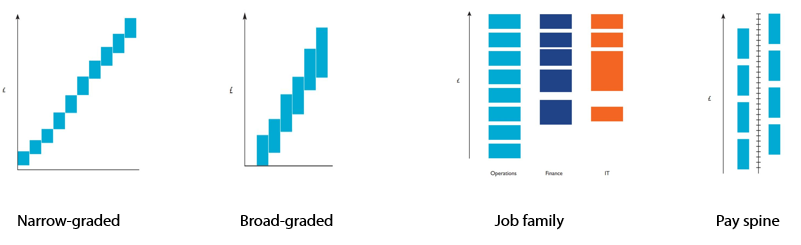
Different pay structures suit different organisations:
Top Tip:
Make sure you involve all relevant stakeholders when determining the guiding principles for the design and operation of the structure; analyse the options and select the ones which best meets the guiding principles (but keep the structure as simple as possible). All models can promote a fair system of pay clearly aligned to the organisation’s culture, values and HR strategy; getting the communication right from the outset is vital, so that everyone understands they are being paid fairly and appropriately. Key messages, communication channels and feedback mechanisms should all be planned alongside the system’s design and implementation.
Job evaluation can ensure that pay levels in the organisation for each role are externally competitive. Whilst matching job titles, brief descriptions, job capsules and job descriptions can be used in benchmarking roles, the framework provided by job evaluation grades is the most accurate way to match internal jobs to external market data sources and ensure that like is compared with like.
Top Tip:
When matching to external sources of market data, always ask the provider if they have grades that link to other job evaluation schemes to ensure you receive the most accurate comparison. Paydata run a number of salary surveys that can be linked to other job evaluation schemes.
The Equal Pay Provisions of the Equality Act 2010 ensure that men and women in the same employment performing equal work receive equal pay. Job evaluation provides the data to support an equal pay audit so that equal pay is being checked across:
Top Tip:
The golden rule for work of equal value is not to assume that different types of jobs (e.g. manual and administrative) cannot be of equal value. While some employment tribunal cases have considered the question ‘what is equal?’ the answer really lies in the application of fair analytical job evaluation. This is the most reliable way of assessing whether jobs are of equal value.
In a career family structure, development paths are clearly set out for each role. These are usually defined by family/level profiles that describe the knowledge, skills, experience and competencies required at each family/level.
Top Tip:
Informed recruitment, career development and succession planning decisions can take place in the context of a wider hierarchy that the framework provides. Individual employees can be encouraged to see what is required of them to get to the next level in the structure. A director can see where there is no natural successor for a particular role and put in place plans to address the issue.
When developing a job evaluation system and the resulting career family structure that best fits the organisation, it is important to involve other HR specialists, including recruitment and learning and development, alongside employees and line managers, to secure buy-in from the outset. Read more about job evaluation and how Paydata can help with our online job evaluation system PayGrade.
Lead Reward Consultant
Date: 11 February 2026
Date: 11 December 2025
Date: 16 October 2025
Date: 16 February 2026
Date: 11 February 2026
Date: 5 February 2026
We are a leading source of UK salary data and provide the expertise, insights and tools to help HR professionals manage their pay and reward practices.
Paydata Ltd
24 Commerce Road
Lynchwood
Peterborough
Cambridgeshire
PE2 6LR
Be the first to hear about upcoming events and stay up to date with regular insights on pay and reward.
© Paydata Ltd 2026 All rights reserved | Registered in England no: 3632206 | VAT no: 728 0808 28
Site by i3MEDIA